

Manufacturing is undergoing a significant digital transformation, with digital twins emerging as a foundational technology enabling manufacturers to represent, diagnose, predict, and optimize their operations.1 These virtual replicas of physical assets and processes offer the potential to deepen understanding of complex systems, optimize production schedules, and simulate various scenarios for enhanced decision-making.2 Unity, a powerful real-time 3D development platform initially known for its capabilities in the gaming industry, has proven to be exceptionally well-suited for creating digital twins in industrial and manufacturing contexts.3 Its robust features for real-time rendering, 3D modeling, simulation, and integration with diverse data sources make it an ideal choice for this purpose.
This report presents a comprehensive three-level plan for developing a digital twin of a manufacturing plant using the Unity game engine. The plan is structured to progressively enhance the capabilities of the digital twin, focusing on real-time monitoring, virtual representation, and advanced analytics/optimization. Level 1 establishes the foundation for real-time monitoring by integrating live data from the plant into Unity. Level 2 focuses on creating a realistic and interactive virtual representation of the manufacturing environment. Finally, Level 3 integrates advanced analytics and optimization tools to enable predictive maintenance, process improvement, and data-driven decision-making. This phased approach allows for a systematic implementation, maximizing value at each stage while addressing potential challenges associated with using Unity for industrial digital twins. Furthermore, the report will briefly explore the potential of augmented reality (AR) and virtual reality (VR) technologies within the digital twin framework to further enhance training, remote assistance, and visualization capabilities.
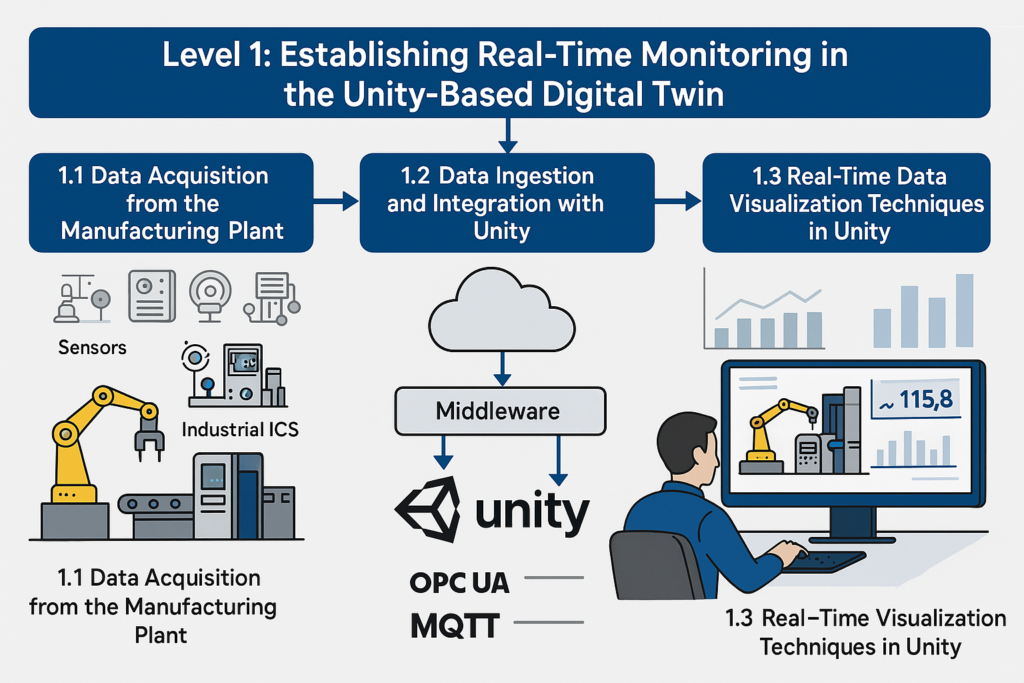
1. Level 1: Establishing Real-Time Monitoring in the Unity-Based Digital Twin
1.1 Data Acquisition from the Manufacturing Plant
The initial stage of creating a digital twin involves establishing a robust system for acquiring real-time data from the manufacturing plant. A multitude of data sources are typically present in such environments, including sensors monitoring various parameters, cameras providing visual feeds, industrial control systems (ICS) such as Supervisory Control and Data Acquisition (SCADA) systems, Distributed Control Systems (DCS), and Programmable Logic Controllers (PLCs) that manage and control machinery.7 Additionally, the increasing prevalence of the Industrial Internet of Things (IIoT) has introduced a wide array of connected devices capable of transmitting operational data.3 Enterprise-level systems like Manufacturing Execution Systems (MES) and Enterprise Resource Planning (ERP) systems also hold valuable information regarding production schedules, inventory levels, and overall operational performance.2
Industrial data acquisition (DAQ) systems play a crucial role in this ecosystem by collecting, analyzing, and storing data from these diverse sources.17 These systems are designed for durability and high performance, converting analog and digital signals into time-stamped digital data that can be used for real-time monitoring, control, and further analysis.17 A wide range of IoT sensors are deployed in manufacturing to monitor critical parameters such as temperature to prevent overheating, vibration to detect potential mechanical failures, pressure in hydraulic and pneumatic systems, gas levels for safety, humidity to ensure optimal operating conditions, and location for tracking assets and personnel.13 The availability of this real-time data is paramount for manufacturers to detect issues faster, optimize production performance dynamically, and ultimately improve the quality of their products.7 However, a significant challenge lies in integrating data from legacy systems and the diverse array of modern data sources, which often present unique complexities due to varying communication protocols and data formats.7
1.2 Data Ingestion and Integration with Unity
To leverage the acquired real-time data within the Unity-based digital twin, effective data ingestion and integration mechanisms are essential. Unity, while primarily a game engine, offers several avenues for connecting to external data streams.3 Middleware or connector technologies serve as crucial bridges between industrial systems and the Unity environment. OPC Unified Architecture (UA) and Message Queuing Telemetry Transport (MQTT) are prominent standards in industrial communication that can facilitate this integration.3 Unity’s networking capabilities can be utilized to establish real-time data streaming, and the Unity Asset Store offers various third-party plugins that simplify the integration with protocols like MQTT.3
Furthermore, Application Programming Interfaces (APIs) and data streaming services provided by cloud platforms can be leveraged for integrating data stored or processed in the cloud.4 For instance, data from IoT platforms like AWS IoT or Azure IoT Hub can be streamed into Unity for visualization and analysis. The availability of pre-built Unity assets and third-party libraries for MQTT integration significantly simplifies the process of connecting Unity to IoT data, highlighting the advantage of utilizing Unity’s extensive ecosystem for rapid development.22 Leveraging cloud platforms for data integration also provides scalability and access to advanced data processing and analytics services, further enhancing the capabilities of the digital twin.
1.3 Real-Time Data Visualization Techniques in Unity
Once real-time data is ingested into Unity, the platform offers a rich set of tools and techniques for intuitive and informative visualization. Sensor data, machine status updates, and production metrics can be displayed directly on the 3D models of the plant and its equipment.3 For example, the color or texture of a machine component can change based on its temperature or operational status. Numerical data can be overlaid as labels or integrated into custom Human-Machine Interfaces (HMIs) within the virtual environment.3
Beyond direct model visualization, Unity supports the creation of interactive charts, graphs, and dashboards to represent trends and key performance indicators (KPIs) in real time.3 Libraries and assets are available within the Unity ecosystem to facilitate the creation of these visual elements. Furthermore, Unity’s Simulation Foundation package provides tools for visualizing various types of messages, including sensor data, with default configurations for common message types and APIs for creating custom visualizations.40 Techniques such as 2D windows displaying the latest data on a topic and 3D in-scene drawings representing the data can be employed to provide comprehensive real-time insights.
2. Level 2: Creating a Realistic Virtual Representation in Unity
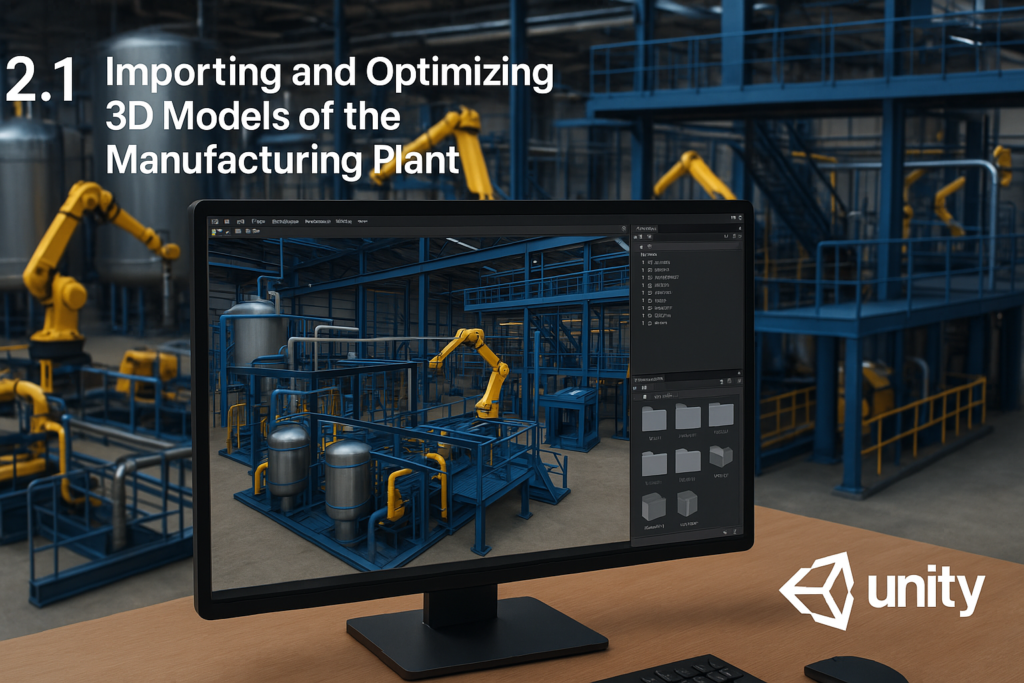
2.1 Importing and Optimizing 3D Models of the Manufacturing Plant
The second level of the plan focuses on building a realistic virtual representation of the manufacturing plant within Unity. This involves importing existing 3D models, such as CAD (Computer-Aided Design) and BIM (Building Information Modeling) data, into the Unity environment.4 Unity supports several native 3D file formats, including FBX, OBJ, and others.43 However, for seamless import of complex industrial data, specialized plugins like Pixyz are highly beneficial as they can handle a wider range of CAD and BIM formats while preserving metadata and hierarchical structures.6
Once the 3D models are imported, optimizing them for real-time performance within Unity is crucial, especially for large and detailed factory environments.48 Techniques such as reducing polygon counts, using Level of Detail (LOD) to render less detail for distant objects, optimizing the number of materials, and employing texture atlasing can significantly improve rendering efficiency.44 Tools like Pixyz offer automated optimization features and the ability to create custom rules for streamlining the optimization process.44
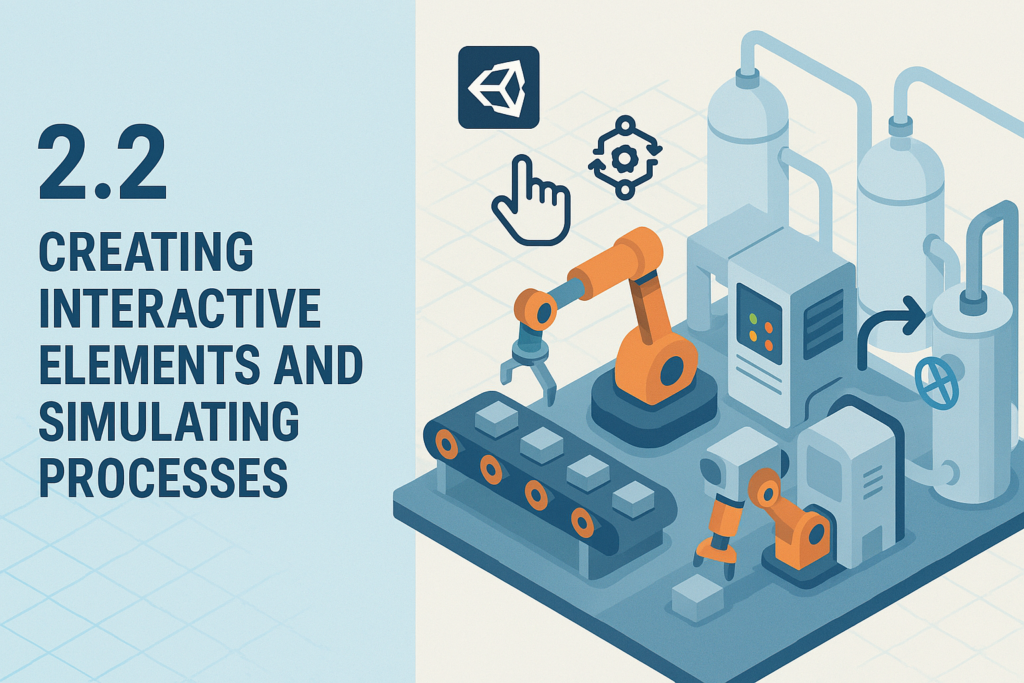
2.2 Creating Interactive Elements and Simulating Processes
To transform the static 3D model into an interactive virtual representation, it is necessary to add interactive elements and simulate the dynamic processes occurring within the manufacturing plant.3 Unity’s scripting capabilities in C# allow developers to create custom behaviors for virtual objects, enabling interactions such as opening and closing valves, starting and stopping machinery, and moving objects along conveyor belts.58
Physics simulation within Unity can be used to accurately represent the movement and interaction of physical objects, such as parts on an assembly line or the operation of robotic arms.59 Additionally, visual scripting tools within Unity can provide a more accessible way for non-programmers to add interactivity. By connecting the real-time data streams to these interactive elements, the virtual representation can dynamically reflect the actual state of the manufacturing plant, providing an immersive and informative experience.4
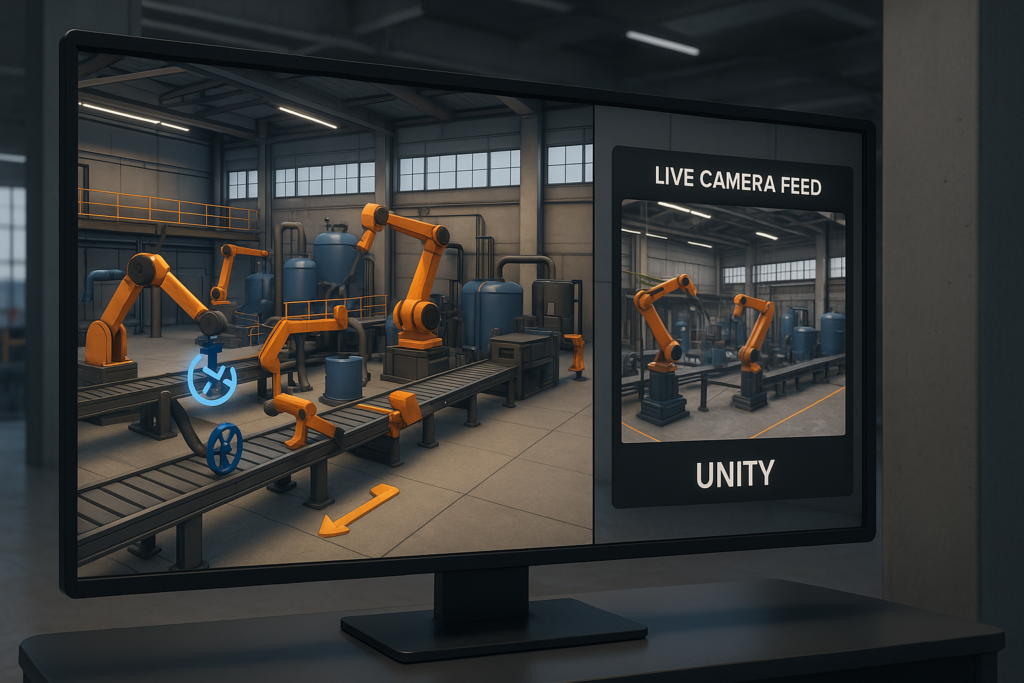
2.3 Integrating Live Camera Feeds into the Virtual Environment
An important aspect of creating a realistic virtual representation is the integration of live camera feeds from the physical plant into the Unity environment.3 Unity allows rendering the output of a virtual camera to a Render Texture, which can then be applied as a texture to a 3D object within the scene, such as a monitor screen in the virtual control room.64
Similarly, live video feeds from IP cameras in the physical plant can be streamed into Unity and displayed on virtual screens.66 This can be achieved using Unity’s networking capabilities or specialized plugins that support video streaming protocols like RTSP.73 Integrating these live camera feeds provides operators and other stakeholders with a direct visual connection to the physical plant floor from within the digital twin, enhancing situational awareness and remote monitoring capabilities.
3. Level 3: Implementing Advanced Analytics and Optimization
3.1 Integrating Unity with Advanced Analytics Tools and Platforms
The third level of the plan focuses on integrating the Unity-based digital twin with advanced analytics tools and platforms to enable predictive maintenance, process optimization, and enhanced decision-making.1 Unity can act as a powerful visualization front-end for analytics data generated by external systems. For instance, data from machine learning platforms used for predictive maintenance can be visualized in Unity, showing predicted failure probabilities or remaining useful life (RUL) of equipment.77
Integration with cloud-based data analytics services, such as those offered by Databricks, can provide access to scalable data processing and machine learning capabilities.90 Unity can connect to these platforms via APIs to retrieve and visualize analytical insights. Furthermore, the digital twin can be integrated with simulation software for process optimization, allowing manufacturers to simulate different scenarios and identify the most efficient operating parameters.4
3.2 Enabling Predictive Maintenance within the Digital Twin
Predictive maintenance is a key application of advanced analytics within a manufacturing digital twin.77 By integrating machine learning models that analyze real-time sensor data and historical performance data, the digital twin can predict potential equipment failures before they occur.77 Unity can visualize these predictions, highlighting at-risk equipment and providing insights into the estimated time to failure or recommended maintenance actions.91
This proactive approach can significantly reduce unplanned downtime, decrease maintenance costs, and optimize asset performance.7 The digital twin can also facilitate the planning and scheduling of maintenance activities, ensuring that resources are allocated efficiently and disruptions to production are minimized. Anomaly detection algorithms can further enhance predictive maintenance capabilities by identifying unusual patterns in equipment behavior that may indicate impending failures.77
3.3 Supporting Process Optimization and Enhanced Decision-Making
The Unity-based digital twin, integrated with advanced analytics and simulation tools, can provide valuable support for process optimization and enhanced decision-making.1 By visualizing real-time and historical production data, bottlenecks and inefficiencies in the manufacturing process can be easily identified.2 Simulation capabilities allow users to test the impact of potential process changes or new equipment installations in a virtual environment before implementing them in the physical plant.4
Furthermore, the digital twin can be used to perform “what-if” scenario analyses, allowing stakeholders to understand the potential consequences of different decisions related to production scheduling, resource allocation, and supply chain management.2 The integration of AI-powered analytics can provide insights into demand forecasting, quality control, and overall equipment effectiveness (OEE), enabling manufacturers to make data-driven decisions that optimize efficiency, reduce costs, and improve product quality.
4. Challenges and Limitations of Using Unity for a Manufacturing Plant Digital Twin
While Unity offers numerous advantages for creating a manufacturing plant digital twin, certain challenges and limitations should be considered. The initial investment in terms of software licenses, development time, and the need for specialized skills in both Unity development and industrial systems can be significant.4 Integrating diverse industrial data sources, especially from legacy equipment, can present technical hurdles requiring custom solutions and middleware.4
Ensuring data accuracy and real-time synchronization between the physical plant and the digital twin is critical but can be challenging due to network latency, data transmission reliability, and the need for robust data management practices.4 Optimizing the performance of the Unity environment for large-scale and complex factory models with real-time data updates and interactive elements requires careful attention to 3D model optimization and efficient coding practices.48 Furthermore, maintaining the security and privacy of sensitive operational data within the digital twin environment is paramount and necessitates robust cybersecurity measures.4
Potential solutions and workarounds for these challenges include adopting a phased implementation approach, starting with focused areas of the plant and gradually expanding the scope.134 Utilizing specialized Unity plugins and assets designed for industrial applications can streamline data integration and optimization.3 Implementing robust data validation and error handling mechanisms can help ensure data accuracy. Leveraging cloud-based services for data processing and storage can address scalability and performance concerns. Finally, adhering to industry best practices for security and data privacy is essential throughout the digital twin development and deployment process.
5. Potential for Augmented Reality (AR) and Virtual Reality (VR) in the Digital Twin Implementation
Unity’s native support for augmented reality (AR) and virtual reality (VR) technologies presents significant opportunities to enhance the functionality and user experience of the manufacturing plant digital twin.3
For training purposes, VR can provide immersive and interactive simulations of complex procedures or emergency scenarios, allowing employees to practice in a safe and controlled virtual environment.3 AR can be used for remote assistance, enabling off-site experts to guide on-site technicians through maintenance or repair tasks by overlaying digital instructions and information onto their view of the physical equipment.3
Furthermore, AR and VR can enhance data visualization, allowing users to interact with the digital twin in a more intuitive and engaging manner. For example, AR overlays can display real-time sensor data directly on the physical equipment, while VR can provide immersive walkthroughs of the plant or allow for collaborative design reviews in a shared virtual space.3 The ability to deploy Unity applications across a wide range of platforms, including mobile devices and AR/VR headsets, makes it a versatile tool for implementing these enhanced visualization and interaction capabilities.3
6. Conclusion
The development of a digital twin for a manufacturing plant using the Unity game engine presents a compelling opportunity for organizations to enhance their operational efficiency, improve decision-making, and drive innovation. The three-level plan outlined in this report provides a structured approach to progressively build a comprehensive digital twin, starting with real-time monitoring, advancing to a realistic virtual representation, and culminating in the integration of advanced analytics and optimization capabilities.
Unity’s unique combination of powerful real-time 3D rendering, extensive cross-platform deployment capabilities, and a rich ecosystem of tools and assets makes it a strong contender for industrial digital twin applications. While challenges related to data integration, performance optimization, and security need to be carefully addressed, the potential benefits in terms of cost reduction, improved productivity, and enhanced safety are substantial. Furthermore, the integration of AR and VR technologies within the Unity-based digital twin holds the promise of revolutionizing training, remote assistance, and data visualization in the manufacturing sector, paving the way for smarter, more connected, and more efficient factories of the future.
Works cited
- Digital Twins for Advanced Manufacturing | NIST, accessed on April 1, 2025, https://www.nist.gov/programs-projects/digital-twins-advanced-manufacturing
- Digital twins: The next frontier of factory optimization – McKinsey & Company, accessed on April 1, 2025, https://www.mckinsey.com/capabilities/operations/our-insights/digital-twins-the-next-frontier-of-factory-optimization
- Digital Twins in the Machinery & Robotics Industry – Unity, accessed on April 2, 2025, https://unity.com/blog/digital-twins-machinery-robotics-industry
- Introduction to Digital Twins with Unity – Unity Learn, accessed on April 2, 2025, https://learn.unity.com/tutorial/introduction-to-digital-twins-with-unity
- What are Digital Twins and How do They Work? – Unity, accessed on April 2, 2025, https://unity.com/topics/digital-twin-definition
- Augmented & Virtual Reality Solutions for Manufacturing | Unity, accessed on April 2, 2025, https://unity.com/solutions/manufacturing
- Real-time Production Monitoring in Manufacturing: The Data-Driven Edge – 7Rivers, accessed on April 1, 2025, https://7riversinc.com/insights/real-time-production-monitoring-in-manufacturing-the-data-driven-edge/
- What is Real-Time Production Monitoring? – Click Maint CMMS, accessed on April 1, 2025, https://www.clickmaint.com/glossary/real-time-production-monitoring
- What Is Real-Time Monitoring In Manufacturing – P3 Adaptive, accessed on April 1, 2025, https://p3adaptive.com/what-is-real-time-monitoring-in-manufacturing/
- Production Monitoring for Manufacturers – Mingo Smart Factory, accessed on April 1, 2025, https://www.mingosmartfactory.com/production-monitoring/
- SCADA – Wikipedia, accessed on April 1, 2025, https://en.wikipedia.org/wiki/SCADA
- industrial control system (ICS) – Glossary – NIST Computer Security Resource Center, accessed on April 1, 2025, https://csrc.nist.gov/glossary/term/industrial_control_system
- Industrial IoT Sensors: What Are They and Which Businesses Use Them – UpKeep, accessed on April 1, 2025, https://upkeep.com/learning/industrial-iot-sensors-businesses/
- IoT in Manufacturing: Applications and Benefits of Smart Factories | Digi International, accessed on April 1, 2025, https://www.digi.com/blog/post/iot-in-manufacturing
- 10 Ways IoT Improves Quality Control in Manufacturing, accessed on April 1, 2025, https://www.iotforall.com/10-ways-iot-improves-quality-control-in-manufacturing
- www.digi.com, accessed on April 1, 2025, https://www.digi.com/blog/post/iot-in-manufacturing#:~:text=IoT%20sensors%20for%20manufacturing%2C%20along,wireless%20networks%20to%20the%20cloud.
- Industrial DAQ Systems | KEYENCE America, accessed on April 1, 2025, https://www.keyence.com/products/daq/data-loggers/resources/data-logger-resources/industrial-daq-systems.jsp
- Choosing data acquisition technology that benefits smart factories – Control Engineering, accessed on April 1, 2025, https://www.controleng.com/choosing-data-acquisition-technology-that-benefits-smart-factories/
- Data Acquisition Systems – Rugged | Industrial | Distributed, accessed on April 1, 2025, https://www.ueidaq.com/data-acquisition-systems
- IoT in Manufacturing: 6 Industrial IoT Trends in 2025 – MobiDev, accessed on April 1, 2025, https://mobidev.biz/blog/industrial-iot-internet-of-things-trends
- IoT & Murata Sensors | Sensors | Murata Manufacturing Co., Ltd., accessed on April 1, 2025, https://www.murata.com/products/sensor/library/iot
- MQTT-Arduino-and-Unity | DTLab Documentation, accessed on April 2, 2025, https://docs.dtlab.eaisi.tue.nl/books/software-documentation/page/mqtt-arduino-and-unity
- MQTT for Unity3D – YouTube, accessed on April 2, 2025, https://www.youtube.com/watch?v=B7-jVInEZTk
- Bridging Realms: Integrating MQTT and Siemens SCADA into Unity’s 3D Worlds – YouTube, accessed on April 2, 2025, https://www.youtube.com/watch?v=fNP9cYg98ZE
- MQTT for Unity – RocWorks, accessed on April 2, 2025, https://www.rocworks.at/wordpress/?p=1307
- Connecting Unity and AWS IoT: A Step-by-Step Guide to MQTT Integration – Medium, accessed on April 2, 2025, https://medium.com/@sameerhassan77/connecting-unity-and-aws-iot-a-step-by-step-guide-to-mqtt-integration-3dac1f8b245
- Unity | RocWorks, accessed on April 2, 2025, https://www.rocworks.at/wordpress/?cat=47
- MQTT Tutorial for Arduino, ESP8266 and ESP32 – DIYI0T, accessed on April 2, 2025, https://diyi0t.com/introduction-into-mqtt/
- 04: Unity AR and Realtime Data – CE Workshops, accessed on April 2, 2025, https://workshops.cetools.org/codelabs/casa0019-04-unity-ar-vuforia/index.html?index=..%2F..index
- webgl – Creating a digital twin of a moving robot in unity web server – Stack Overflow, accessed on April 2, 2025, https://stackoverflow.com/questions/77111046/creating-a-digital-twin-of-a-moving-robot-in-unity-web-server
- Unity 3D with MQTT SparkplugB connectivity – YouTube, accessed on April 2, 2025, https://www.youtube.com/watch?v=rZRAuncq13I
- Installation Guide – Best Packages Documentation Hub, accessed on April 2, 2025, https://bestdocshub.pages.dev/MQTT/installation/
- Using MQTT in Unity with M2MqttUnity Library: A Step-by-Step Guide | EMQ – EMQX, accessed on April 2, 2025, https://www.emqx.com/en/blog/using-mqtt-in-unity-with-m2mqttunity-library-a-step-by-step-guide
- unreliablecode/Unity-MQTT-Manager – GitHub, accessed on April 2, 2025, https://github.com/unreliablecode/Unity-MQTT-Manager
- How to Use MQTT in C# with MQTTnet | EMQ – EMQX, accessed on April 2, 2025, https://www.emqx.com/en/blog/connecting-to-serverless-mqtt-broker-with-mqttnet-in-csharp
- Using MQTT with C# [Step By Step Tutorial For MQTT Integration] – M2MQTT C# – YouTube, accessed on April 2, 2025, https://www.youtube.com/watch?v=7UewJo4zY2k
- I want to connect the IoT realtime data to unity 3D with ARcore – Learn Microsoft, accessed on April 2, 2025, https://learn.microsoft.com/en-us/answers/questions/518141/i-want-to-connect-the-iot-realtime-data-to-unity-3
- Realtime Unity Data with Google Sheets | Third Aurora Augmented …, accessed on April 2, 2025, https://m.youtube.com/watch?v=zgSES5PQNu8
- AI and Digital Twins in Manufacturing: Case Studies – YouTube, accessed on April 2, 2025, https://www.youtube.com/watch?v=U89tcPnue3k
- Visualize Sensor Data | Unity Simulation, accessed on April 2, 2025, https://docs.unity3d.com/Simulation/manual/author/set-up-sensors/visualize-sensor-data.html
- Unity Industry: Transform 3D Data to Build Anything, accessed on April 2, 2025, https://unity.com/products/unity-industry
- How to Use Digital Twins in Retail | Unity, accessed on April 2, 2025, https://unity.com/topics/digital-twins-for-retail
- How to Import 3D CAD Models into Unity, accessed on April 2, 2025, https://cadexchanger.medium.com/how-to-import-3d-cad-models-into-unity-d922317ca040
- Intro to the Unity Industrial Collection, Part 1: Importing and Optimizing 3D Data, accessed on April 2, 2025, https://www.engineering.com/intro-to-the-unity-industrial-collection-part-1-importing-and-optimizing-3d-data/
- How do I import Models from my 3D app? – Unity – Manual, accessed on April 2, 2025, https://docs.unity3d.com/530/Documentation/Manual/HOWTO-importObject.html
- Pixyz – Automate CAD Data and Optimize Mesh Models – Unity, accessed on April 2, 2025, https://unity.com/products/pixyz
- Unity Industry Product Walkthrough: Demos & Tutorials, accessed on April 2, 2025, https://unity.com/campaign/unity-industry-product-walkthrough-demos
- Creating models for optimal performance – Unity – Manual, accessed on April 2, 2025, https://docs.unity3d.com/Manual/ModelingOptimizedCharacters.html
- Configuring your Unity project for stronger performance, accessed on April 2, 2025, https://unity.com/how-to/project-configuration-and-assets
- Optimizing CAD Data for Real-Time 3D Visualization – Unity, accessed on April 2, 2025, https://create.unity.com/optimizing-cad-data-for-real-time-3d-visualization?utm_source=linkedin&utm_medium=cpc&utm_campaign=nxt_abm_ind_emea_emea_en_co_soc-li_acq_pr_2023-07_dt-ind-skl-xr-snr_cc3022_dt-co1_id:201087456&utm_content=g-wp_s-sgl_nm:pixwp1-01-sz:1080x1080_dt-ind-skl-xr-snr_a_all_emea_co_id:287566096
- How to use the factory pattern for object creation at runtime – Unity Learn, accessed on April 2, 2025, https://learn.unity.com/tutorial/how-to-use-the-factory-pattern-for-object-creation-at-runtime
- How extended reality reinvents the factory floor – Unity, accessed on April 2, 2025, https://unity.com/resources/how-xr-reinvents-manufacturing
- The power of Unity in AI, accessed on April 2, 2025, https://unity.com/blog/industry/the-power-of-unity-in-ai
- Robotics simulation in Unity is as easy as 1, 2, 3, accessed on April 2, 2025, https://unity.com/blog/engine-platform/robotics-simulation-is-easy-as-1-2-3
- Top 10 Applications & Use Cases for Digital Twins – Unity, accessed on April 2, 2025, https://unity.com/topics/digital-twin-applications-and-use-cases
- Immersive 3D Design Review & Collaboration Tool – Unity, accessed on April 2, 2025, https://unity.com/solutions/immersive-3d-collaboration
- High Demand Of Unity Digital Twin: Application, Process, & How To Get It – Best Certified BIM, AutoCAD, Revit And AutoDesk Training, accessed on April 2, 2025, https://interscaleedu.com/en/blog/bim/high-demand-of-unity-digital-twin/
- Visual Studio IDE: Unity Games Development Tools – Microsoft, accessed on April 2, 2025, https://visualstudio.microsoft.com/vs/unity-tools/
- Physics solutions for game development – Unity, accessed on April 2, 2025, https://unity.com/solutions/programming-physics
- Performance optimization tips: Physics in Unity | Tutorial – YouTube, accessed on April 2, 2025, https://www.youtube.com/watch?v=pTz3LMQpvfA
- Welcome to Unity Simulation, accessed on April 2, 2025, https://docs.unity3d.com/Simulation/
- Creating Digital Twins with Unity feat. Team Kauda of #OAK2021 …, accessed on April 2, 2025, https://www.youtube.com/watch?v=fB0xhyHBiP0
- Connecting your Digital Twin to the Unity Game Engine – YouTube, accessed on April 2, 2025, https://www.youtube.com/watch?v=Zb5GecN-2Lg
- Render a camera view to a Render Texture – Unity – Manual, accessed on April 2, 2025, https://docs.unity3d.com/6000.0/Documentation/Manual/output-to-render-texture.html
- Unity Basics – Render Texture to make a JumboTron or Live TV in game – YouTube, accessed on April 2, 2025, https://www.youtube.com/watch?v=mm69034k7eo
- How to Make a Live Camera Feed Effect in Unity [Unity Tutorial] – YouTube, accessed on April 2, 2025, https://www.youtube.com/watch?v=HW5PnclAqBg
- Display live camera feed in Unity – Stack Overflow, accessed on April 2, 2025, https://stackoverflow.com/questions/19482481/display-live-camera-feed-in-unity
- Video Streaming Component | Unity Render Streaming | 3.1.0-exp.9 – Unity – Manual, accessed on April 2, 2025, https://docs.unity3d.com/Packages/com.unity.renderstreaming@3.1/manual/video-streaming.html
- Rendering to a Render Texture | Universal RP | 7.2.1 – Unity – Manual, accessed on April 2, 2025, https://docs.unity3d.com/Packages/com.unity.render-pipelines.universal@7.2/manual/rendering-to-a-render-texture.html
- How to Put a Camera View on a Game Object Using a Render Texture – Unity – YouTube, accessed on April 2, 2025, https://www.youtube.com/watch?v=RF3hdwVLrus
- how to add in-game screens (CCTV, security camera) in unity – YouTube, accessed on April 2, 2025, https://www.youtube.com/watch?v=tzNAyWCNdJA
- Basic Security Camera System in Unity – Unity C# Tutorial – YouTube, accessed on April 2, 2025, https://www.youtube.com/watch?v=ixnnXbzY688
- Viewing the RTSP Stream URI – Avigilon Documentation, accessed on April 2, 2025, https://docs.avigilon.com/bundle/video-intercom-camera-web-interface/page/original/WebUI/WebUI_ConfigRTSP.htm
- How To Get Started with Unity Render Streaming & Cloud Gaming Tutorial – YouTube, accessed on April 2, 2025, https://www.youtube.com/watch?v=zsDHTDAXaE0
- External Systems – IP-Based Camera Add page – Avigilon Documentation, accessed on April 2, 2025, https://docs.avigilon.com/bundle/unity-access-user-7-10/page/Image_devices_-_New.htm
- Most efficient way to incorporate CCTV screens in Unity? : r/Unity3D – Reddit, accessed on April 2, 2025, https://www.reddit.com/r/Unity3D/comments/2z7u4c/most_efficient_way_to_incorporate_cctv_screens_in/
- Machine Learning Algorithms for Predictive Maintenance in Manufacturing – ResearchGate, accessed on April 1, 2025, https://www.researchgate.net/publication/382805856_Machine_Learning_Algorithms_for_Predictive_Maintenance_in_Manufacturing
- The role of digital twin in advanced manufacturing – Siemens US, accessed on April 1, 2025, https://www.siemens.com/us/en/company/topic-areas/advanced-manufacturing/digital-twin-in-advanced-manufacturing.html
- Digital Twins in Manufacturing Explained: Key Advantages and Implementation Insights, accessed on April 1, 2025, https://www.dataparc.com/blog/digital-twin-manufacturing/
- Digital Twin in Manufacturing and Beyond | Plastics Engineering, accessed on April 1, 2025, https://www.plasticsengineering.org/2024/10/digital-twin-in-manufacturing-and-beyond-006884/
- AI-Driven Process Optimization in Manufacturing – IIoT World, accessed on April 1, 2025, https://www.iiot-world.com/smart-manufacturing/ai-driven-process-optimization-in-manufacturing/
- AI-Powered Process Optimization: Boosting Efficiency in Manufacturing – – Datategy, accessed on April 1, 2025, https://www.datategy.net/2024/12/05/ai-powered-process-optimization-boosting-efficiency-in-manufacturing/
- Revolutionizing Industrial Manufacturing: The Convergence of AI, Advanced Analytics, and Batch Process Optimization | The AI Journal, accessed on April 1, 2025, https://aijourn.com/revolutionizing-industrial-manufacturing-the-convergence-of-ai-advanced-analytics-and-batch-process-optimization/
- AI Analytics in Manufacturing: Top Use Cases & Benefits, accessed on April 1, 2025, https://bitsorchestra.com/idea/ai-analytics-in-manufacturing
- How is AI being used in Manufacturing – IBM, accessed on April 1, 2025, https://www.ibm.com/think/topics/ai-in-manufacturing
- What is Digital Twin Technology? – AWS, accessed on April 1, 2025, https://aws.amazon.com/what-is/digital-twin/
- Game Insights & Analytics Dashboard Software – Unity, accessed on April 2, 2025, https://unity.com/products/unity-analytics
- Unity Central | Industrial Manufacturing Supply Chain | Predictive Process Intelligence, accessed on April 2, 2025, https://supplychain.boardwalktech.com/industries/industrial-manufacturing
- Unity & Unity Cloud – Intellective, accessed on April 2, 2025, https://www.intellective.com/unity/
- Manufacturing Solutions | Databricks Platform, accessed on April 2, 2025, https://www.databricks.com/solutions/industries/manufacturing-industry-solutions
- Real-time 3D solutions for Energy – Unity, accessed on April 2, 2025, https://unity.com/solutions/energy
- Databricks Unity Catalog Integration: Future of DataOps – Datagaps, accessed on April 2, 2025, https://www.datagaps.com/blog/databricks-unity-catalog-integration-dataops/
- Databricks Unity Catalog Explained: A Complete Guide to Modern Data Governance, accessed on April 2, 2025, https://www.credencys.com/blog/databricks-unity-catalog-explained/
- Predictive Maintenance with Machine Learning: A Complete Guide | SPD Technology, accessed on April 1, 2025, https://spd.tech/machine-learning/predictive-maintenance/
- Predictive Maintenance and More: How to Use Machine Learning Without Being a Data Scientist – YouTube, accessed on April 1, 2025, https://m.youtube.com/watch?v=zXcp2HvpJLE&pp=ygUPI2VzaWNfaXBfcG9ydGFs
- How AI Is Used in Predictive Maintenance | Neural Concept, accessed on April 1, 2025, https://www.neuralconcept.com/post/how-ai-is-used-in-predictive-maintenance
- Predictive Maintenance in Manufacturing Using Machine Learning – MobiDev, accessed on April 1, 2025, https://mobidev.biz/blog/predictive-maintenance-in-manufacturing-using-machine-learning
- How to Use Machine Learning for Predictive Maintenance – YouTube, accessed on April 2, 2025, https://www.youtube.com/watch?v=BApzsgq32mM
- Artificial Intelligence for Predictive Maintenance Applications: Key Components, Trustworthiness, and Future Trends – MDPI, accessed on April 2, 2025, https://www.mdpi.com/2076-3417/14/2/898
- Applied Predictive Maintenance in Aviation: Without Sensor Data – YouTube, accessed on April 2, 2025, https://www.youtube.com/watch?v=82KiWQqmKWU
- The power of predictive analytics – Unity Learn, accessed on April 2, 2025, https://learn.unity.com/tutorial/66cfa1d0edbc2a0569c0ecc6
- Databricks Data Streaming Platform, accessed on April 2, 2025, https://www.databricks.com/product/data-streaming
- Using Unity Catalog with Structured Streaming | Databricks Documentation, accessed on April 2, 2025, https://docs.gcp.databricks.com/en/structured-streaming/unity-catalog.html
- Using Unity Catalog with Structured Streaming – Azure Databricks – Learn Microsoft, accessed on April 2, 2025, https://learn.microsoft.com/en-us/azure/databricks/structured-streaming/unity-catalog
- Predictive optimization for Unity Catalog managed tables – Azure Databricks, accessed on April 2, 2025, https://learn.microsoft.com/en-us/azure/databricks/optimizations/predictive-optimization
- Predictive optimization for Unity Catalog managed tables – Databricks Documentation, accessed on April 2, 2025, https://docs.databricks.com/aws/en/optimizations/predictive-optimization
- Unity Catalog best practices – Databricks Documentation, accessed on April 2, 2025, https://docs.databricks.com/aws/en/data-governance/unity-catalog/best-practices
- What is Databricks Unity Catalog? – Secoda, accessed on April 2, 2025, https://www.secoda.co/learn/what-is-databricks-unity-catalog
- Databricks Unity Catalog: Data Governance, accessed on April 2, 2025, https://www.databricks.com/product/unity-catalog
- Getting started with the Databricks Unity Catalog – Fractal Analytics Inc., accessed on April 2, 2025, https://fractal.ai/blog/getting-started-with-databricks-unity-catalog/
- Configure a Databricks Unity Catalog Integration | Documentation – 2024.2 LTS, accessed on April 2, 2025, https://documentation.immuta.com/2024.2/data-and-integrations/databricks-unity-catalog/how-to-guides/configure
- Set up and manage Unity Catalog – Databricks Documentation, accessed on April 2, 2025, https://docs.databricks.com/aws/en/data-governance/unity-catalog/get-started
- Set up and manage Unity Catalog – Azure Databricks | Microsoft Learn, accessed on April 2, 2025, https://learn.microsoft.com/en-us/azure/databricks/data-governance/unity-catalog/get-started
- Databricks Unity Catalog: A Beginner’s Guide – DataCamp, accessed on April 2, 2025, https://www.datacamp.com/tutorial/databricks-unity-catalog-guide
- Databricks Unity Catalog Connection – Ataccama ONE, accessed on April 2, 2025, https://docs.ataccama.com/one/latest/sources/databricks-unity-catalog-connection.html
- Databricks Unity Catalog – Alteryx Help Documentation, accessed on April 2, 2025, https://help.alteryx.com/current/en/designer/data-sources/databricks/databricks-unity-catalog.html
- Connect to and manage Azure Databricks Unity Catalog in Microsoft Purview, accessed on April 2, 2025, https://learn.microsoft.com/en-us/purview/register-scan-azure-databricks-unity-catalog
- The Simulation Series, Part III: Discrete Event Simulation – Actalent, accessed on April 1, 2025, https://www.actalentservices.com/en/insights/articles/the-simulation-series-part-three-discrete-event-simulation
- How Discrete Event Simulation Helps Manufacturers Make Better Decisions – Autodesk, accessed on April 1, 2025, https://www.autodesk.com/blogs/design-and-manufacturing/2024/12/31/how-discrete-event-simulation-helps-manufacturers-make-better-decisions/
- Discrete Event Simulation (DES) for Production Planning and Scheduling (PPS), accessed on April 1, 2025, https://www.vms-solutions.com/en/blog/blog-view.php?idx=13
- Process Optimization through Discrete Event Simulation – Descar Tech, accessed on April 1, 2025, https://descar.tech/news/process-optimization-through-discrete-event-simulation/
- Discrete Event Simulation | Autodesk, accessed on April 1, 2025, https://www.autodesk.com/solutions/discrete-event-simulation
- Augment assembly work planning with digital human simulations – Unity, accessed on April 2, 2025, https://unity.com/blog/industry/augment-assembly-work-planning-with-digital-human-simulations
- Optimize the deployment with Distributed Rendering | Unity Simulation, accessed on April 2, 2025, https://docs.unity3d.com/Simulation/manual/deploy/optimize-the-deployment-distributed-rendering.html
- The real-time production cycle – Unity Learn, accessed on April 2, 2025, https://learn.unity.com/tutorial/the-real-time-production-cycle
- The Real-time Revolution – Unity 3D for industrial use-cases – YouTube, accessed on April 2, 2025, https://www.youtube.com/watch?v=mh5ygjpvS78
- Manufacturing Discrete Event Simulation using UNITY – Part 01 – YouTube, accessed on April 2, 2025, https://www.youtube.com/watch?v=KVBWBPbS4BI
- Free and open-source PLC driven warehouse/manufacturing simulation made with Unity, accessed on April 2, 2025, https://www.plctalk.net/threads/free-and-open-source-plc-driven-warehouse-manufacturing-simulation-made-with-unity.135855/
- Digital Twin – UNITY Consulting & Innovation, accessed on April 2, 2025, https://www.unity-consulting.com/en/consulting-services/digital-twin/
- Leveraging Machine Learning to Enhance Anomaly Detection in Rotating Machinery, accessed on April 2, 2025, https://www.turbomachinerymag.com/view/leveraging-machine-learning-to-enhance-anomaly-detection-in-rotating-machinery
- How Carl’s Jr. uses immersive tech to reinvent facility operations – Unity, accessed on April 2, 2025, https://unity.com/resources/carls-jr-digital-twin
- Unity Central | Supply Chain Monitoring & Anomaly Detection – Boardwalktech, accessed on April 2, 2025, https://supplychain.boardwalktech.com/platform-features/real-time-and-proactive-anomaly-detection
- Anomaly Detection for Industrial Processes and Machinery with MATLAB – YouTube, accessed on April 2, 2025, https://www.youtube.com/watch?v=JptIYNEoXxA
- Digital twins: How to build the first twin | McKinsey, accessed on April 1, 2025, https://www.mckinsey.com/capabilities/mckinsey-digital/our-insights/digital-twins-how-to-build-the-first-twin
- Steps for Successful Digital Twin Implementation – Toobler, accessed on April 1, 2025, https://www.toobler.com/blog/digital-twin-implementation
- 8 Manufacturing Processes Improved with AR, VR & MR | Unity, accessed on April 2, 2025, https://unity.com/resources/manufacturing-processes-improved-with-ar-vr-mr
- Implementing mixed reality in smart factory, unity meta quest 3 app : r/MetaQuestVR – Reddit, accessed on April 2, 2025, https://www.reddit.com/r/MetaQuestVR/comments/1jfpbvo/implementing_mixed_reality_in_smart_factory_unity/
- Transformative Power of Real-Time 3D for Industries – Unity, accessed on April 2, 2025, https://unity.com/resources/transformative-power-real-time-3d-industries
- Unity Industry Onboarding Guide, accessed on April 2, 2025, https://unity.com/onboardingsuccess/unity-industry-onboarding-guide
- Best Practices For Creating Industry XR Applications | Unity, accessed on April 2, 2025, https://unity.com/resources/best-practices-develop-xr-industry-applications
